ThriftBooks: New & Used Books
- 4.1
- Rating
- 1.00M
- Installs
- Free
- Price
 Analysis by App-foxy
I use book-shopping apps differently from reading apps: I open them when I already have a title in mind, when I want to compare editions, or when I am trying to build a small reading pile without paying full list price. ThriftBooks: New & Used Books fits that practical habit. It is a free Books & Reference app from Thrift Books Global, LLC., built around browsing and buying books rather than reading them inside the app.
Its main appeal is the size of the catalogue and the possibility of finding used copies at a lower cost than new retail editions. The store description points to more than thirteen million new and used books, with savings of up to eighty percent off list price. I would not treat the maximum saving as a promise for every title, but it explains the app’s purpose clearly: this is a discovery and shopping tool for readers who care about selection and price.
How ThriftBooks works in everyday use
I find the app most useful as a deliberate shopping stop, not somewhere I browse just to pass time: I can check whether a title is worth pursuing before committing to a physical copy. That makes edition checking and deciding how much condition matters part of the routine, rather than afterthoughts. From there, the key question is how those choices affect the books I already own and the way I shop.
You May Also Like

 Blood Strike: 2.5 Anniversary
Blood Strike’s Loadouts Turn Every Drop Into a Tactical Gamble
A close look at Blood Strike’s custom loadouts: how fast access to signature weapons reshapes its battle royale rhythm, rewards preparation, and narrows the gap between fights.

 Pandora - Music & Podcasts
Pandora’s Music Is Easy to Start, but Harder to Recover
Pandora’s strength is its low-effort path from a seed to a station. Its weak spot is how much confidence it asks you to place in connection, setup, and quiet recovery.

 8 Ball Pool
 Is Built on Rivalries, Rematches, and Routine
A close look at the rivalries, rematches, shared routines, and unanswered safety questions that turn a quick pool match into a persistent mobile community.

 Samsung Music
’s Quiet Strength Is Playing What You Already Own
Its reach comes less from spectacle than from dependable access to a personal library. That simplicity is both the app’s strongest retention engine and its ceiling.

 AccuWeather: Weather Radar
AccuWeather Review: A Quick, Clear Forecast for Everyday Decisions
For everyday plans, the best forecast is the one you can understand quickly. AccuWeather makes rain timing, radar, and local conditions easy to act on, with a few trade-offs.

 Hill Climb Racing
Why Hill Climb Racing Still Turns Crashes Into One More Run
A tiny car, a bumpy hill and one more upgrade: Hill Climb Racing keeps resurfacing because its simple chaos makes every near-miss feel personal.
More From Our News Desk



A free app with a very specific job
The app itself is free, so there is no paid download standing between me and the catalogue. That matters because I can install it simply to check whether a particular book is available, compare the choices, and decide later whether an order makes sense. The cost begins with the books I choose, not with access to the app.
That distinction is important. ThriftBooks is not a free library, a subscription reading service, or an app that turns a phone into an e-reader. Its value comes from helping me shop for physical books. If I want instant access to a digital novel, a library lending app or an ebook store is usually a better match. If I want a paperback, hardcover, or used copy delivered as part of a normal book purchase, this app is much more relevant.
The interface is easiest to understand when I approach it with a purpose. Searching for a known author, title, or subject is more useful than opening it expecting a guided reading experience. I can use the broad catalogue to investigate older books, school reading, reference material, or series entries that may be harder to spot in a local shop.
Why the large catalogue changes the shopping process
A catalogue of this scale is useful for books that are not currently prominent. New releases are easy to find almost anywhere, but older paperbacks, out-of-print-looking titles, niche nonfiction, and books from a series often require more patient searching. ThriftBooks gives that search a natural home because new and used inventory are part of the same shopping experience.
My most useful workflow is to search by exact title first, then check the author and edition details before getting attached to a result. For a novel, a different cover may not matter. For a textbook, workbook, annotated edition, translation, or collectible copy, it can matter a lot. A low price is not automatically good value if the edition is wrong for the purpose.
I also find the app more useful for building a planned order than for impulse browsing. I might keep a short list of titles, check which versions are available, and then decide whether the combined purchase is worthwhile. That approach reduces the risk of buying the first inexpensive copy without thinking about format, condition, or whether I actually need the book now.
What the cost claim means in practice
The app is free to download, while the books are paid purchases. That makes the value question more nuanced than simply calling it a “free book app.” The free part is the shopping access; the financial benefit depends on the individual listing, the condition, the edition, and the final order details.
The advertised savings of up to eighty percent off list price can be attractive for used books, especially when I am flexible about appearance. Still, “up to” describes the best end of a range, not the normal price of every item. Some books may offer a modest reduction, while others may be much more compelling. I judge each title separately rather than assuming the catalogue-wide claim applies uniformly.
This is also where comparing alternatives helps. A local used-book shop lets me inspect condition immediately and avoid waiting for delivery. A library may cost less for a temporary read, while an ebook store can be preferable when I need the text right away. ThriftBooks becomes stronger when I want to own a physical copy and the available used price is meaningfully below the new alternative.
Small decisions that protect the value of an order
One practical habit is to search for the exact edition instead of stopping at the first matching cover. This is especially important for educational books, technical references, cookbooks, and illustrated titles. The content can change between editions, and a used listing that looks inexpensive may not serve the assignment or project I have in mind.
Another useful habit is to separate “want to read” from “need this edition.” For casual fiction, I can usually prioritize a readable, affordable copy. For a gift, a reference shelf, or a book with visual material, I may care more about condition and presentation. The app is most valuable when I make that decision before ordering rather than after the package arrives.
I would also use the catalogue to research availability before visiting a physical store, not necessarily as a replacement for every local purchase. If I am looking for several books by one author or a complete run of a series, the app can show whether the search is likely to be productive. If I only want one inexpensive paperback today, the local shop may still be faster and simpler.
Where the experience has friction
The biggest tradeoff is that a huge selection can make choosing slower. More results do not automatically mean a clearer decision. When several editions, formats, and conditions appear, I have to read carefully instead of treating the cheapest result as the winner.
Used-book shopping also requires realistic expectations. A used copy can be excellent value when I care about the text more than cosmetic perfection, but it may be a poor choice for a present or a pristine collection. The app’s business model naturally appeals more to practical readers than to people who want every book to look new on the shelf.
There is another simple limitation: the app does not remove the need to think about timing. A physical purchase is different from downloading an ebook or borrowing a digital copy. If I need a title for tonight’s class, a trip tomorrow, or an immediate reference question, I would check a library or digital option first. ThriftBooks is better suited to planned ownership than urgent access.
How it compares with familiar alternatives
Compared with a general online marketplace, ThriftBooks feels more focused on books. That focus is useful when I want to search across a very broad selection without sorting through unrelated products. Compared with a local used bookstore, it offers a more convenient way to investigate titles beyond what happens to be on one shop’s shelves, but I lose the ability to inspect a copy in person before buying.
Compared with a library app, the purpose is completely different. A library is ideal when I want to read temporarily and return the item without building a personal collection. ThriftBooks makes more sense when I want the book to remain mine, perhaps because I plan to reread it, annotate it, lend it, or keep it for reference.
Compared with an ebook retailer, the choice comes down to physical ownership versus immediate digital convenience. The latter usually wins for travel and instant reading. ThriftBooks wins when the feel, permanence, resale possibility, or shelf presence of a physical book matters to me.
A realistic weekend example
Imagine I am planning a weekend reading project and want three older titles, not necessarily the newest editions. I can search each title, compare the available versions, and decide whether used copies are acceptable. For a paperback novel, I may choose the lower-cost used option. For a study guide, I would slow down and verify the edition because the wrong one could make the purchase useless.
If the results are scattered across different conditions or the total no longer feels worthwhile, I can stop before paying. That is one reason I like the app being free: I can use it as a research step even when I ultimately borrow one title from a library or buy another from a local shop. The app does not force a purchase simply because I opened it.
For a gift, my process would change. I would be more cautious about condition and presentation, and I would compare the used listing with a new copy elsewhere. The lower price may still be attractive, but saving money is not the only measure of value when the recipient expects something polished.
Who will get the most from it
This app is a strong fit for readers who buy several physical books, enjoy older or less mainstream titles, and are comfortable considering used copies. Students may find it useful for locating course-related books, although edition checking is essential. Parents building a home library can also benefit from browsing a wide range of children’s and reference titles without limiting the search to one local shelf.
It is particularly appealing to people who already know how they judge used books. If I am happy with underlining, shelf wear, or a less-than-perfect cover when the price is right, the catalogue can feel generous. If I need pristine condition every time, I will probably spend more time filtering my choices and may prefer new-book retailers.
Collectors should approach it selectively. The broad inventory can help locate a wanted title, but a collector may need edition-specific details and condition standards that make a specialist bookseller or in-person inspection more suitable. The app is better for practical discovery than for assuming that every inexpensive listing is a collectible find.
Who should skip it
I would skip it if my main goal is reading immediately on a phone or tablet. The app’s role is shopping for books, so an ebook platform or library service is more direct for instant access. I would also skip it for a last-minute purchase when delivery timing matters more than selection.
People who dislike used-item uncertainty may find the process frustrating. The potential saving is only useful when I accept the tradeoff between price and perfection. Likewise, someone looking for a highly specialized professional edition should compare carefully with a specialist supplier rather than assuming a broad catalogue guarantees the exact version required.
Reliability signals and app basics
ThriftBooks has been available since February 2017, and the app is developed by Thrift Books Global, LLC. Its current version is 2.1.2 and it supports devices running Android 5.0 or later. Those details make it accessible to many older Android phones, although I would still keep the app updated when possible for the smoothest experience.
Its audience is not limited to a tiny group of collectors. The app has more than a million installs, an average rating of 4.2 from around four and a half thousand ratings, and roughly two thousand written reviews. I read those figures as signs of an established shopping tool, not as proof that every search or purchase will be perfect. The Teen content rating also places it in a broad audience range, while the actual suitability of a book depends on the book itself.
My buying checklist
Before I commit to an order, I run through a short checklist:
- Confirm that the author and title match what I need.
- Check the edition when the book is educational, technical, illustrated, or part of a series.
- Decide whether a used condition is acceptable for this particular purpose.
- Compare the displayed saving with the importance of owning the physical copy.
- Choose a different route if I need immediate digital reading or an item in gift-ready condition.
This checklist sounds simple, but it prevents the most common mistake: judging value from the headline price alone. A cheaper book is valuable when it is the right book, in an acceptable condition, for a purpose that benefits from ownership.
My verdict on the value
I recommend ThriftBooks: New & Used Books to anyone who wants a broad physical-book catalogue and is willing to make thoughtful choices between new and used copies. The free app gives me a low-risk way to search, compare, and plan purchases, while the possible discounts make ownership more approachable than buying every title at list price.
I would not describe it as the best solution for every reading need. It cannot replace a library when temporary access is enough, an ebook store when speed matters, or a local bookseller when I want to inspect condition personally. Its strongest case is narrower and more useful: planned physical-book shopping where selection and potential savings matter more than instant access.
For me, the decision is an easy buy when I have a list of books to own, flexible expectations about condition, and enough time to check editions carefully. I would skip the purchase, though not necessarily the free app, when the title is urgently needed or when the exact edition and presentation are more important than finding a lower price.
FAQs for ThriftBooks: New & Used Books
01What is ThriftBooks and how does it work?
ThriftBooks is an online platform that offers a wide selection of new and used books at discounted prices. Users can browse through thousands of titles across various genres, add them to their cart, and make purchases directly through the app. The platform also provides recommendations based on user preferences and reading history.
02Is ThriftBooks available on both Android and iOS?
Yes, ThriftBooks is available for download on both Android and iOS devices. The app can be found on the Google Play Store for Android users and the Apple App Store for iOS users. This ensures that a wide range of users can access their favorite books conveniently from their mobile devices.
03Are the books on ThriftBooks in good condition?
ThriftBooks offers books in various conditions, ranging from new to used. Each listing provides details about the book's condition, allowing users to make informed decisions. Used books are typically categorized as 'Like New', 'Very Good', 'Good', or 'Acceptable', helping users understand what to expect before purchasing.
04Does ThriftBooks offer any customer rewards or discounts?
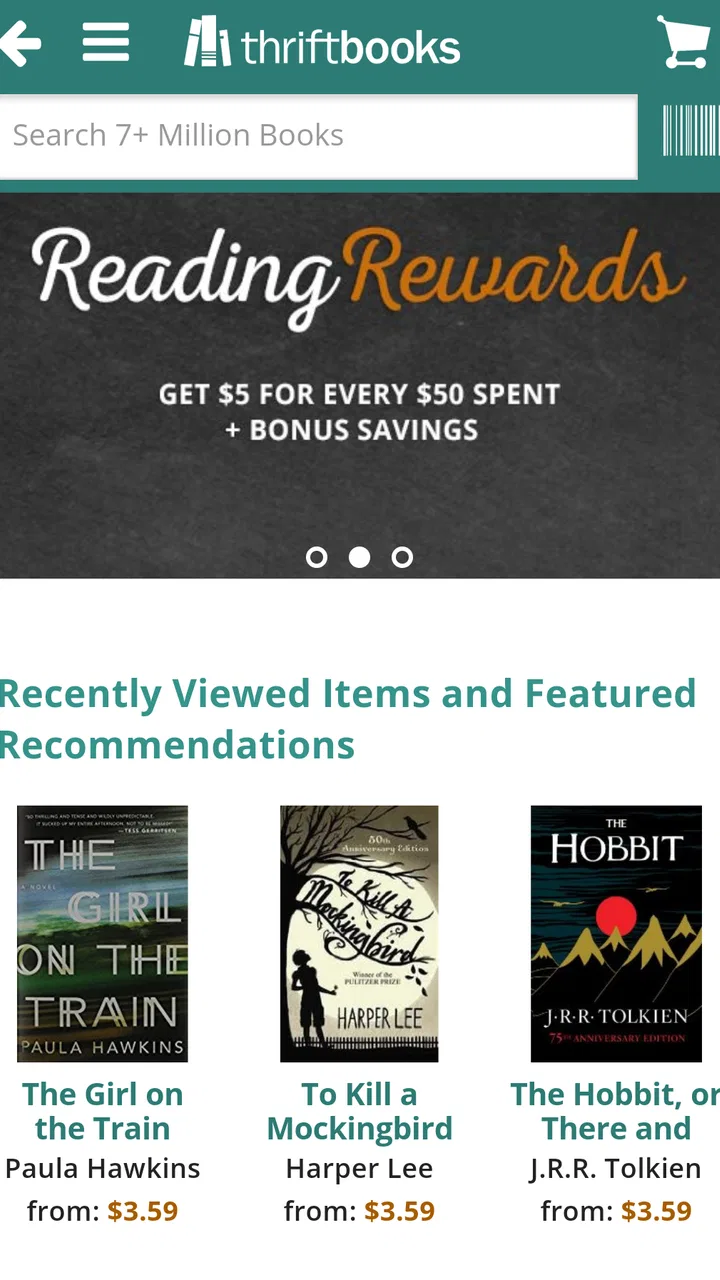
Yes, ThriftBooks has a rewards program called 'ReadingRewards' where users can earn points with every purchase. Accumulated points can be redeemed for discounts on future purchases. Additionally, the app frequently offers special deals and promotions, making it an attractive option for avid readers looking to save money.
05Can I track my order on ThriftBooks?
Yes, once you place an order on ThriftBooks, you can easily track its status through the app. Users receive email notifications with tracking details, and updates are also available within their account on the app, ensuring transparency and peace of mind regarding delivery times and status.
Pros
- Wide selection of new and used books.
- Affordable pricing with frequent discounts.
- User-friendly interface for easy browsing.
- Loyalty program with rewards for purchases.
- Fast and reliable shipping options.
Cons
- Limited availability of rare titles.
- Occasional delays in shipping times.
- Some books may have wear and tear.
- No audiobook options available.
- App requires stable internet connection.

ThriftBooks: New & Used Books
Gallery